I try to incorporate gratitude in my daily life and I am confident that the jolliness here at the bungalow is rooted in the practices that have become a daily pleasure.
Gran never spoke much about gratitude. I don’t suppose the British people of her generation thought much about it, and when they did, seldom talked about it. But she had a quiet appreciation for all things, and that is akin to gratitude. I came to the practice of gratitude the same way, by noticing what the natural world gives me by nature of being there. I used to write a daily list of observations on Facebook. I would note what I could see, hear, touch, smell, taste, and sense in the current moment.Yes, I think we have six senses and will use the verbs sense or know to denote the sixth sense.
Here’s my current list:
- I see the green forest.
- I hear birdsong.
- I touch the warmth of my mug of tea.
- I smell the citrusy fragrance of the candle that honors this act of writing.
- I taste the spicy infusion of chai.
- I sense peace.
By simply noticing, I have framed six things that I appreciate about my day.
Just this year, after reading Braiding Sweetgrass by Robin Wall Kimmerer, I found a practice that gave me a ritual to express my gratitude for the natural world. Dr. Kimmerer wrote about her father’s ritual that he only practiced when he went camping with the family. He would brew coffee each morning and before serving it would pour out a little onto the ground and thank the Spirits of the land. She said that it was his only practice that followed the traditions of their First Nations heritage. (He was raised in a time that traditions were all but wiped out through oppression.) Later on, when she asked him about it, he made light of it and said that the rough and ready coffee he brewed at camp needed to have the first bit thrown out because it was full of grounds. But he also said that it was only when they were at that location that he knew the proper name to address the Spirits.
That got me thinking about the proper name for the spirits of my land. Even if I knew it, I would not use the names that the Nipmuc or the Mohawk nations used to address the deities when these were their lands. That would be cultural appropriation. I also don’t feel I can assume that the spirits honored by the ancient Britons tagged along when I moved here. I am comfortable not knowing their names. I sense their presence in the land and in all things here, and I address my gratitude to them by calling them by the name Spirits of the Place.
What has evolved has been a simple expression of gratitude. I brew my first cup of tea in the morning and take it out on the back porch, regardless of the weather. I observe the day and try to find three things of natural wonder that I am grateful for. Then, I simply thank the Spirits of the Place for those things, and I share my cup of tea with them.
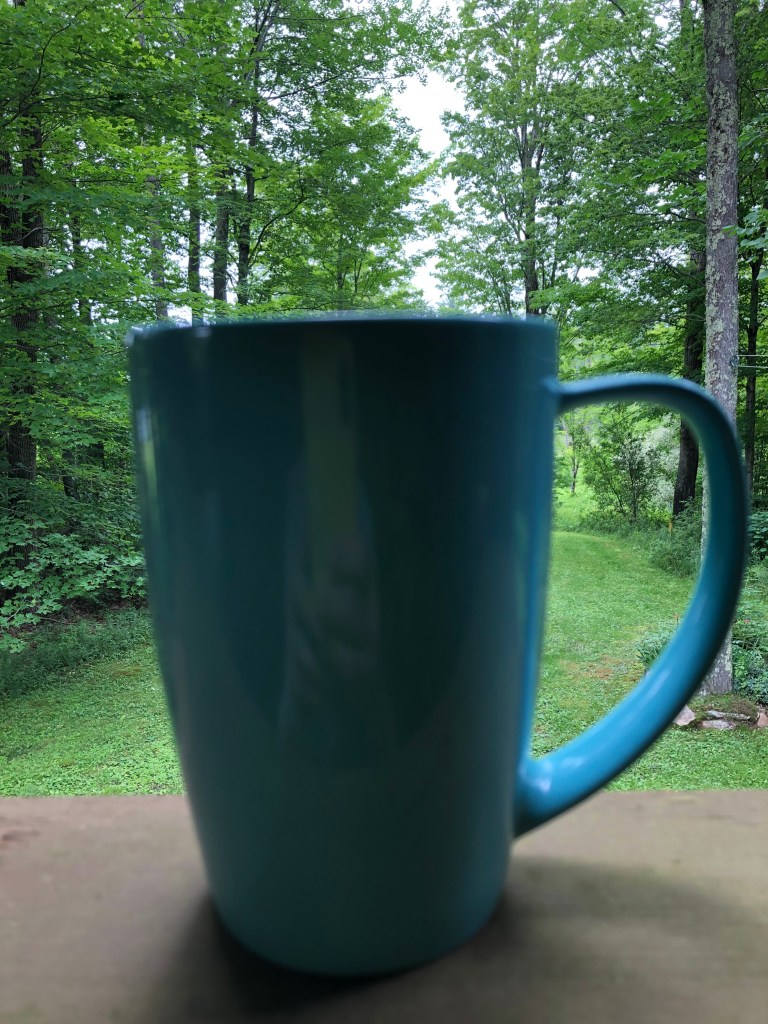
How can you not feel jolly when each day begins in quiet observation and gratitude?


Gratitude and quiet observation of our beautiful world is what centers me. I would like to ask your permission to adopt your morning ritual of tea and gratitude on my own back porch.
LikeLike
Of course you may have tea and contemplation on your porch. I am happy to know you will be joining me.
LikeLike