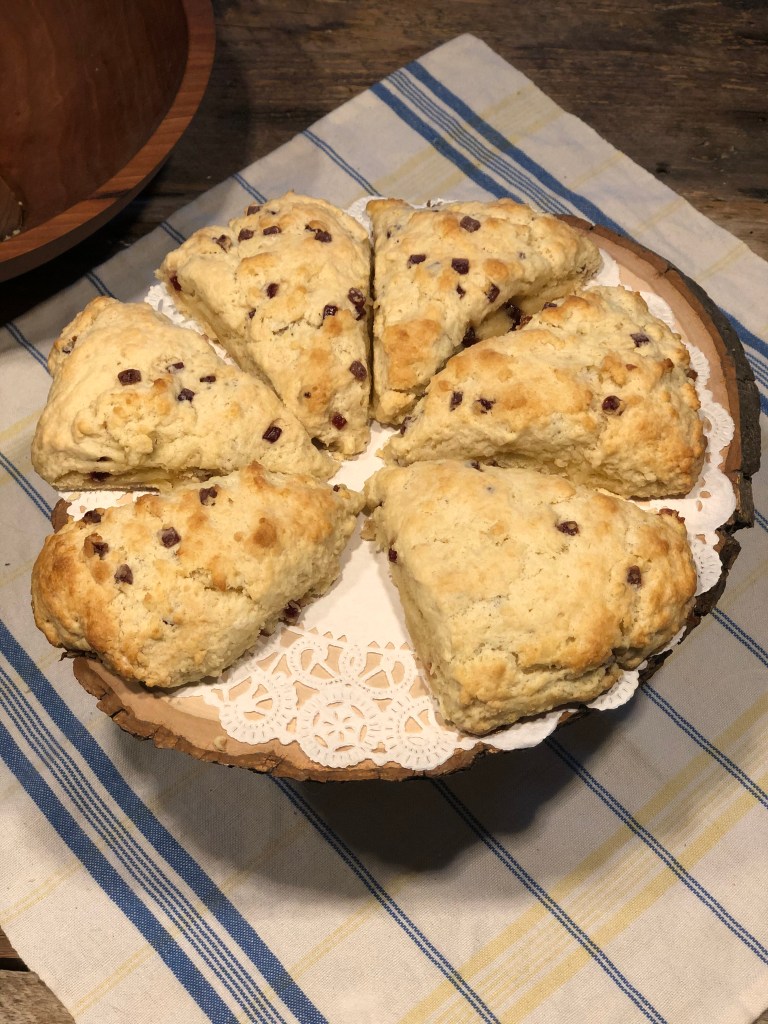
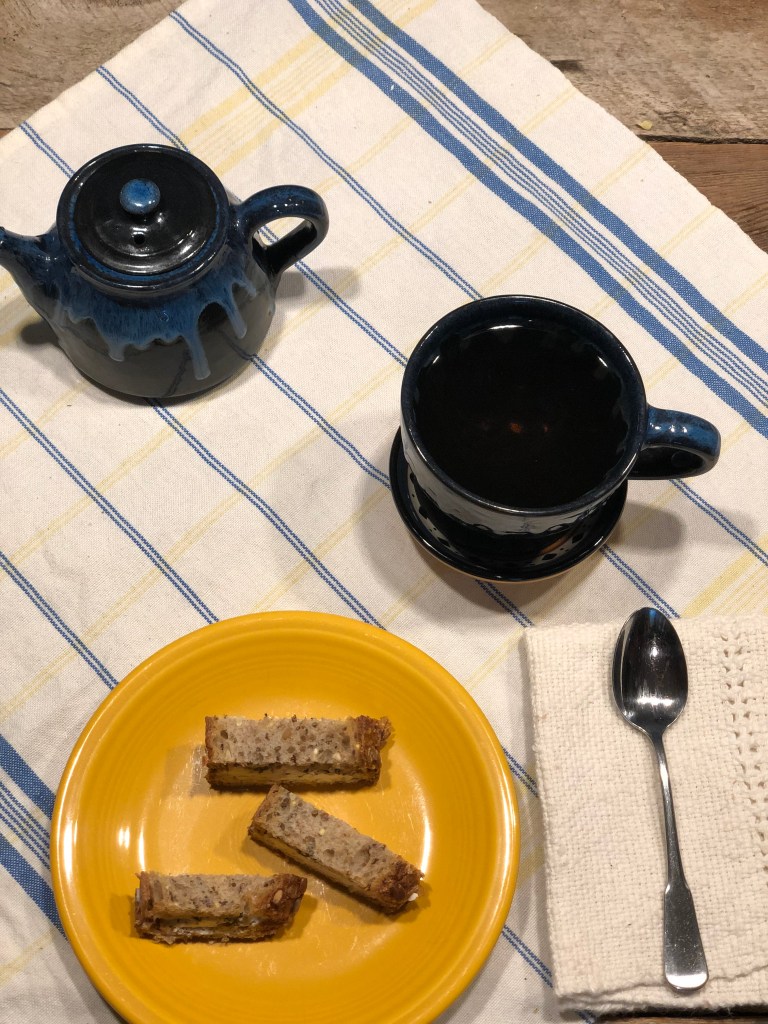
I try to incorporate gratitude in my daily life and I am confident that the jolliness here at the bungalow is rooted in the practices that have become a daily pleasure. 
Gran never spoke much about gratitude. I don’t suppose the British people of her generation thought much about it, and when they did, seldom talked about it. But she had a quiet appreciation for all things, and that is akin to gratitude. I came to the practice of gratitude the same way, by noticing what the natural world gives me by nature of being there. I used to write a daily list of observations on Facebook.  I would note what I could see, hear, touch, smell, taste, and sense in the current moment.Yes, I think we have six senses and will use the verbs sense or know to denote the sixth sense.

Here’s my current list:

  • I see the green forest.
  • I hear birdsong.
  • I touch the warmth of my mug of  tea. 
  • I smell the citrusy fragrance of the candle that honors this act of writing.  
  • I taste the spicy infusion of chai. 
  • I sense peace.

By simply noticing, I have framed six things that I appreciate about my day.

Just this year, after reading Braiding Sweetgrass by Robin Wall Kimmerer, I found a practice that gave me a ritual to express my gratitude for the natural world. Dr. Kimmerer wrote about her father’s ritual that he only practiced when he went camping with the family. He would brew coffee each morning and before serving it would pour out a little onto the ground and thank the Spirits of the land. She said that it was his only practice that followed the traditions of their First Nations heritage. (He was raised in a time that traditions were all but wiped out through oppression.) Later on, when she asked him about it, he made light of it and said that the rough and ready coffee he brewed at camp needed to have the first bit thrown out because it was full of grounds. But he also said that it was only when they were at that location that he knew the proper name to address the Spirits. 

That got me thinking about the proper name for the spirits of my land. Even if I knew it, I would not use the names that the Nipmuc or the Mohawk nations used to address the deities when these were their lands. That would be cultural appropriation. I also don’t feel I can assume that the spirits honored by the ancient Britons tagged along when I moved here. I am comfortable not knowing their names. I sense their presence in the land and in all things here, and I address my gratitude to them by calling them by the name Spirits of the Place.


What has evolved has been a simple expression of gratitude. I brew my first cup of tea in the morning and take it out on the back porch, regardless of the weather. I observe the day and try to find three things of natural wonder that I am grateful for. Then, I simply thank the Spirits of the Place for those things, and I share my cup of tea with them.
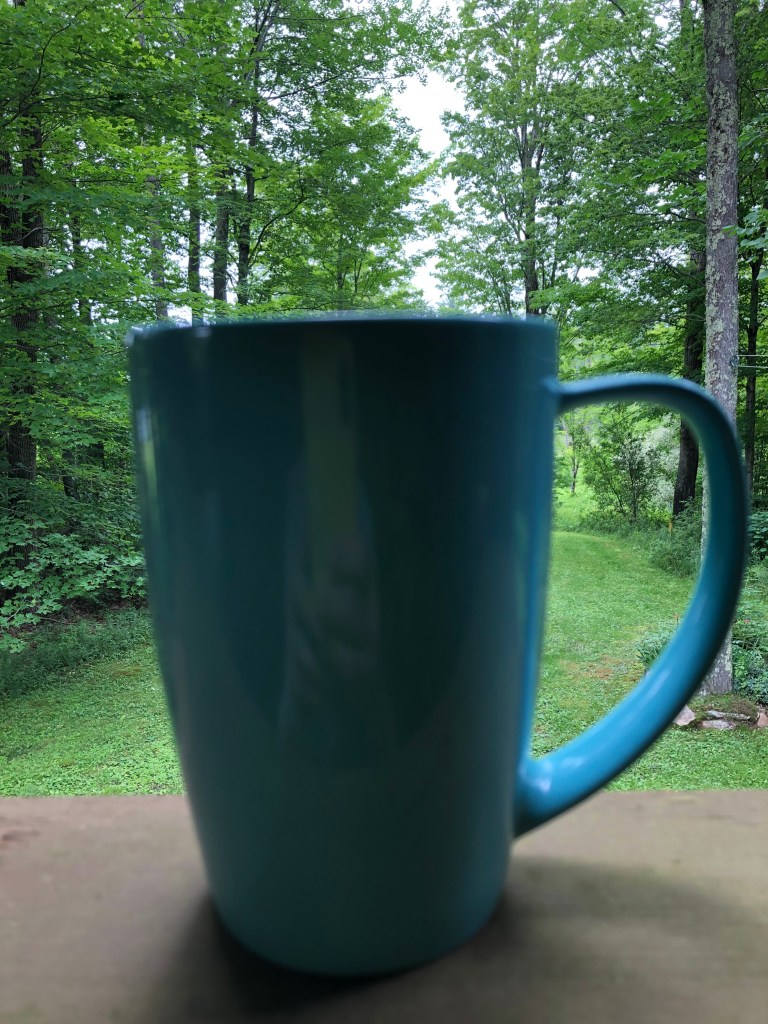

How can you not feel jolly when each day begins in quiet observation and gratitude?
Roadside attractions

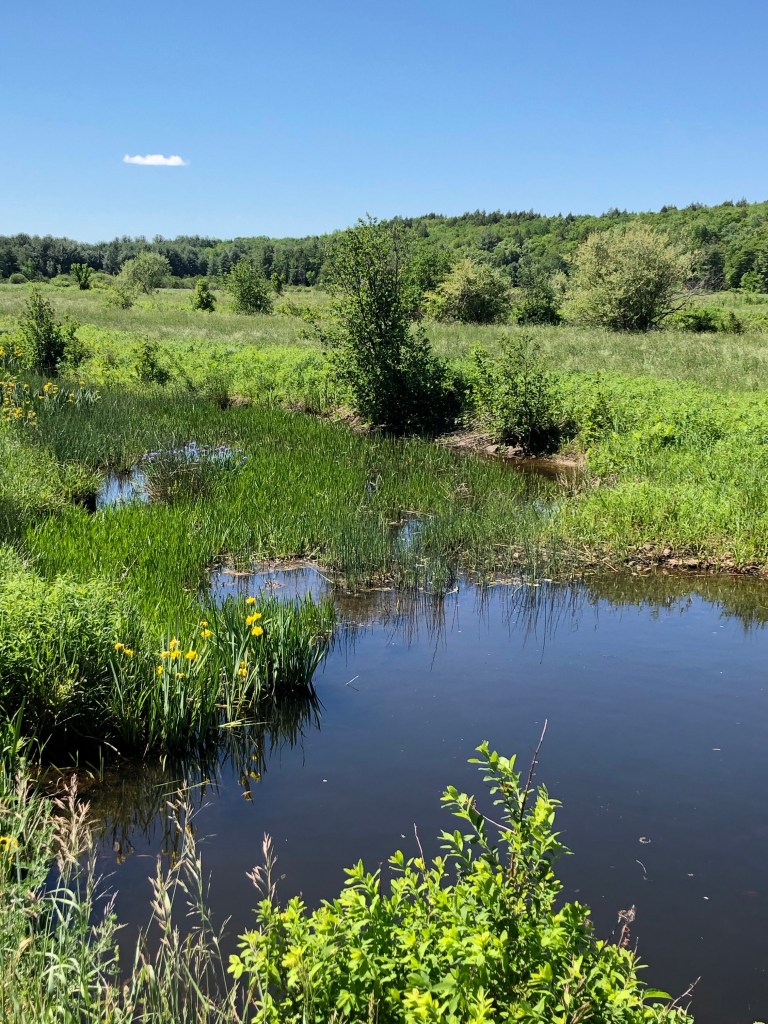
The road crosses a brook, flooded a little by the rain.

As much as I love staying home at the Jolly Bungalow, I cherish my daily walk along the road. This summer, the combination of people working from home plus a major roadworks project in the center of town and a minor roadworks project at the other end of the road have conspired to keep traffic really low. Not that it was ever much in this gentle and sleep town. A traffic jam here is seeing six cars go by in the space of a half hour.

I know that the wildlife really revels in the newfound solitude, because I’ve seen more chipmunks, a larger flock of geese on the pond, and even the occasional deer alongside the road. The butterflies keep me company while our paths coincide and I tell them all love stories. They are incredibly camera shy, and I respect that.

When I walk, I carry a face mask with me, but it’s fairly rare that I have to put it on. There are a couple of walkers and a couple of runners that frequent the road, but we usually managed to miss each other or to wave at each other across the road, a safe four meters apart. 

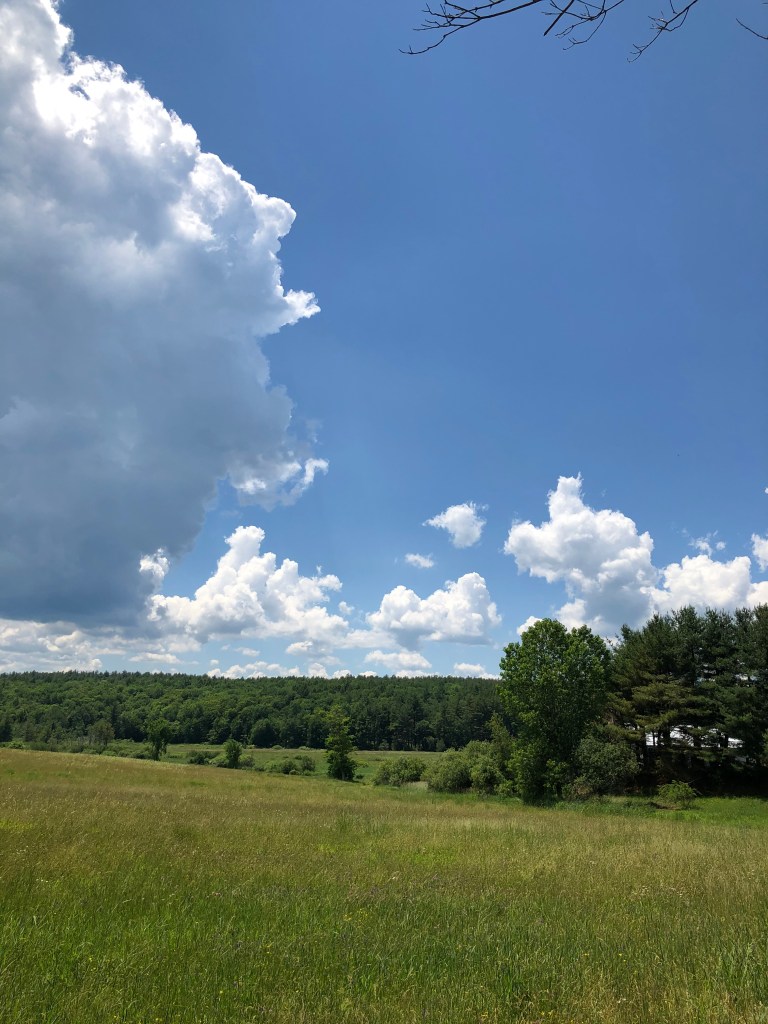
Some days the sky is so beautiful.

At first I hoped for one of these interactions, calling it the social high point of my day. Now that I have become deeply comfortable with solitude, I actually hope that I don’t meet anyone on the road. There are plenty of natural things to engage my interest. The quiet landscape thrills me. I come home with roadside bouquets of clover and daisies. My pockets are often stuffed with pine cones and I cherish each feather that I find. And best of all, the beckoning comfort of the Jolly Bungalow waiting at the end of the walk.

I wish the blue heron had been at home.

Curled up with a good book

My bungalow has a cosy little library. It’s nothing fancy, just a sofa and two chairs surrounded by shelves and shelves of books, photographs and art created by several artists I admire.

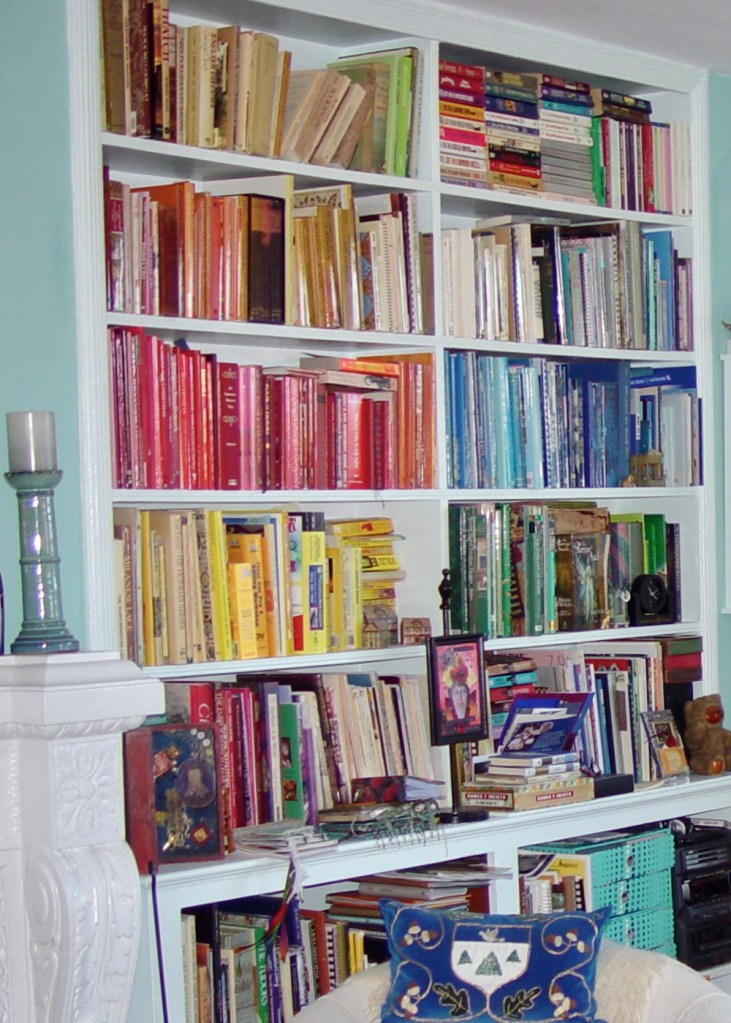
The library at the Jolly Bungalow

The books are either older or rich with images. When it is just words, I accept the convenience of an e-book, yet I can’t imagine having a 21st. century library, filled with comfortable furniture aplenty but not a physical book in sight. I am too much in love with coloful bindings. I also find that books about making art or actually about making anything work better in the physical form. Bookmarks are too awkward in e-books, when you can’t see all of them at once, and recognize them by their color, placement, or form.

When the pandemic first struck, I found that I couldn’t read fiction at all. I felt like I had to keep strict control over my thoughts, and reading fiction has always been about letting your mind wander free and letting the book come deep into your thoughts. I was afraid of what else might seep into my thoughts.

After a couple of months, I am adjusting to the new normal and I felt that I could trust myself to read fiction. I went with something safe and comforting: old novels that I had read before and thus had the visual landscape in my mind already. I began with Phoebe Atwood Taylor/Alice Tilton/Freeman Dana. These novels are set in Boston and Cape Cod and take place in the 1930s and 40s.

Yet, I find that I cannot read the latter part of my mother’s beloved My Friend series by Jane Duncan because life on a sugar plantation, with its overt racism, completely horrifies me.  I think I will only re-read her novels set at Reachfar in Scotland.

One corner of the library at Maplehurst. I did not sort my book by color then, and was always looking hard for a particular title.

I have been reading some newer books as well. The Aunt Dimity series  by Nancy Atherton soothes me.  It’s a cozy mystery series, and things work out for the best at the end of each book. That’s what I need to read: people who are caring, people who fix injustices, and plots that have happy endings. We cannot make a better society by delving too deep into its worst ills. We must visualize a better world and then bring it to fruition. For my sanity, I must concentrate on attracting what is right, and oppose, but not dwell on, what is not.

About today’s photos. They are from various iterations of my library at Maplehurst, The Aerie, and here at the Jolly Bungalow. Yes, the books really are arranged by color now. When I’m looking for a book I tend to recall its title and know the color of the binding and its approximate size. So when I’m looking fthe or my copy of Parnassus on Wheels by Christopher Morley I know that it is a slim volume bound in blue cloth. 

When I moved to The Aerie, my mother commented that I should just sort my books by color and save myself a lot of time in looking for a title. And so I did. She knew that color is my first language. 

Bookshelves at the Aerie, arranged for the first time by color, but not in rainbow order.

Wash day at the Bungalow

Today’s wash day and I am feeling very jolly about it. Any joy that I find in doing the wash is totally mine. I have no inspirations to draw from my foremothers. Gran sent her washing out. That, and, having her groceries bread and milk delivered, were the luxuries that she enjoyed. Running the farm kitchen was enough work for her although she loved it. She had no time for doing laundry.

Mum had a love/hate relationship with doing laundry. In the summer, she would rhapsodize over at the sweet smell of laundry dried on the line, but that was about the extent of her wash day ecstasy.

Now I am absolutely over the moon about it. There is magic in doing laundry. I like the casual attention that you pay to sorting, and checking for spots or missing buttons. I love the magic of soap and water. Best of all I love the laundry line.

My laundry line starts on the back porch and extends to a beech tree across the yard. It’s very high up, because it originates on the second floor and the land drops away down the hill. You can’t actually see much of my laundry because it’s behind the bungalow, but sometimes one or two pieces at the far end of the line are visible from the road if you look carefully. Although they are tiny specks, high up and distant I still choose what I’m going to display there with extreme care. It’s part of the fun. 

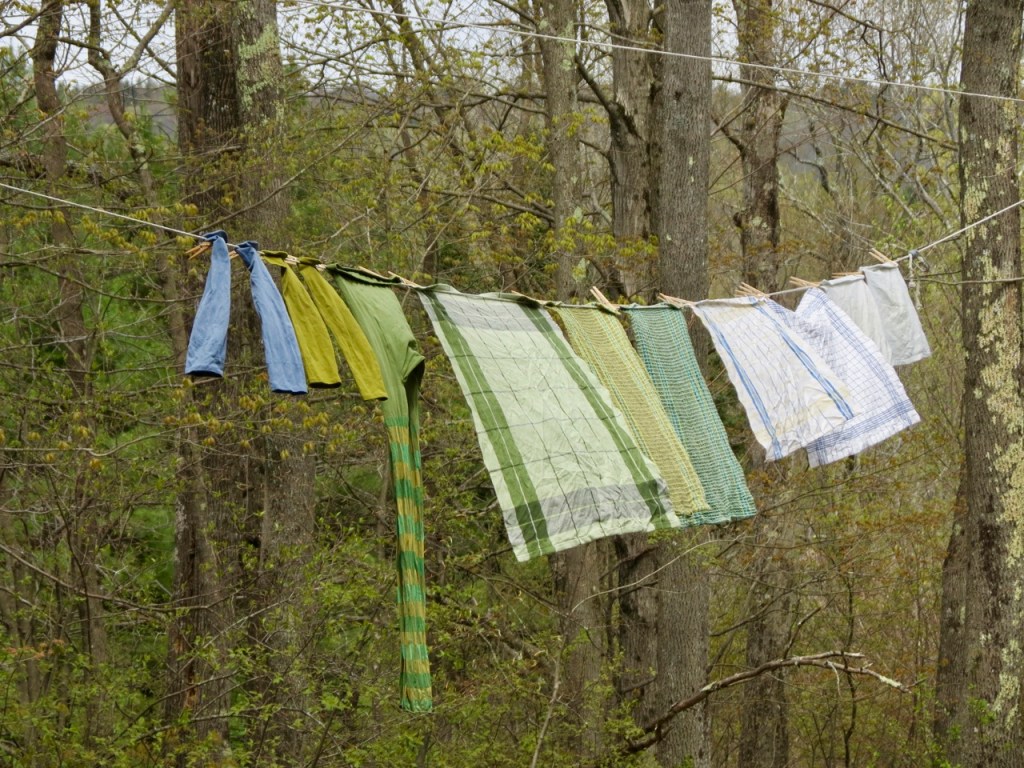
My usual choice is a couple of brightly colored hand-woven tea towels. Sometimes it’s a colorful outfit complete with matching socks or tights. I like making an artful composition of the laundry on the line. Outfits go out together, arranged in colors of the rainbow. Socks are always in pairs, walking toward the distant tree. You’ll have to guess at my taste in dainties, because they are hung closest to the porch and few ever see them.

A study in Blue and Green

I don’t think I could live in a neighborhood that had a covenant that forbade hanging laundry outside. I think that’s an invasion on the private lives of the residents and I don’t think there’s anything disreputable about hanging laundry out to dry. I have unfriended very few people on social media, but there was one person who is insistent that hanging laundry outside was an unspeakable offense, and I just had to realize I had nothing in common with this person or her outlook on life.

Several states have passed Right to Dry legislation, targeting communities that don’t appreciate the environment or the comforting aspects of clothing dried in the fresh air and sun.

My blog is late this week because I worried that the topic was too frivolous in a country torn apart by social justice issues. But, when you shine a harsh light upon white privilege, you realize that laws against hanging laundry outside are but further ways to marginalize people who are struggling financially under the burden of being on the wrong side of privilege. I think we need to let go of the snobbery, celebrate the earth and the diversity of all of her peoples. We need to hang our laundry out, as our ancestors did. Celebrate cleanliness. Look for hidden art in laundry lines. Have some love for your neighbors.

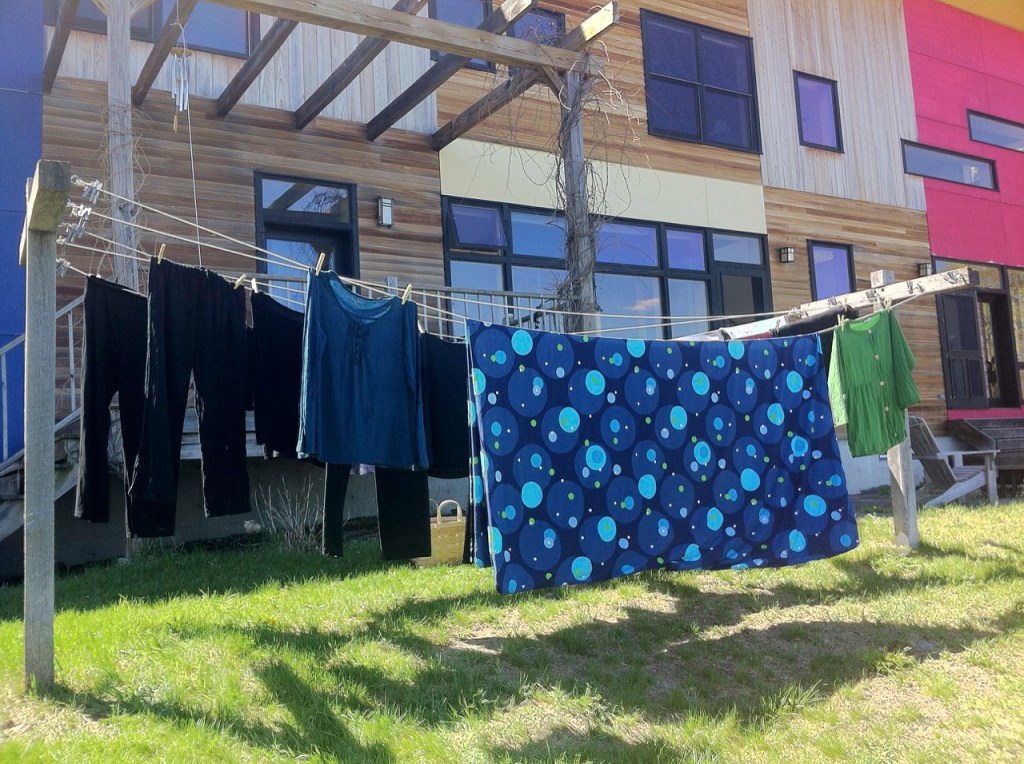
When I lived at Sparrow Hill, the laundry line was in the front yard.

Now, if you’ll excuse me, it looks like rain and I had better take my laundry in.

Twice steeped

Tea is the closest thing I have to a holy sacrament in the bungalow. It’s the (hot) water of life, the thing that gets me out of my nice warm bed on a chilly morning, and the elixir that chases the fog from my brain so that I can sit down to write a coherent sentence. I have a steaming cup of tea beside me right now.

At this stage in the Great Pandemic, I can still get my tea leaves from my favourite purveyor, and I am so grateful for that.

I will carry on with my careful and measured use of my tea leaves, steeping them gently and using them twice. That’s actually the secret of being able to drink so much tea. Most of caffeine all comes out in the first steep. The second steep, paler and weaker, is just flavoured water.

When was a little girl visiting the farm house, the tea kettle was an amazing and huge cauldron to me. It was large, capable of making tea for everyone working in the barns and fields, aka ‘the lads.’ I couldn’t lift it, but Gran could heft it over the four big brown teapots and fill each with a stream of boiling water. The lads liked their tea strong. How strong? Gran said that their tea was strong enough to trot a mouse across it. That’s pretty strong.

There were plenty of daily occasions for tea. It accompanied breakfast, elevenses, lunch, a tea break in the afternoon, usually not posh enough to be a formal afternoon tea, and a final cup after dinner. Extra occasions, like someone dropping by, or a family meeting to discuss serious things, also were times for tea. It supported us through all kinds of crises. My Mum and her teapot presided over some serious neighborhood gatherings, when she would invite the calmest minds together to solve a problem, or the flightiest minds to offer calm reassurance and gentle advice. I grew up having such powerful role models of women solving problems cooperatively, seated in a circle that was anchored by the humble brown pot.

The day after my Mum’s funeral service, I remember getting the tea things together to serve breakfast tea to family members who would soon be returning home. It suddenly hit me that I had inherited the teapot, and all the responsibility that went along with it. I have a small collection of teapots, but when things are serious, I don’t take out the handmade one from Japan or the gaudy Staffordshire one that was a gift from a dear friend. It’s the humble brown one that comes out to work its Magic.

Mending day at the Jolly Bungalow

Yesterday was wash day at the bungalow and today is mending day.  I know the traditional routine puts ironing after wash day, but in all honesty,  I don’t iron much.  I favor the gently rumpled look of natural fibers dried in the wind. Mending day is an infrequent ritual and I take a  whimsical approach to the task. I do not try to make neat invisible stitches, looking instead upon mending as an excuse to go a little bit wild with color and texture.

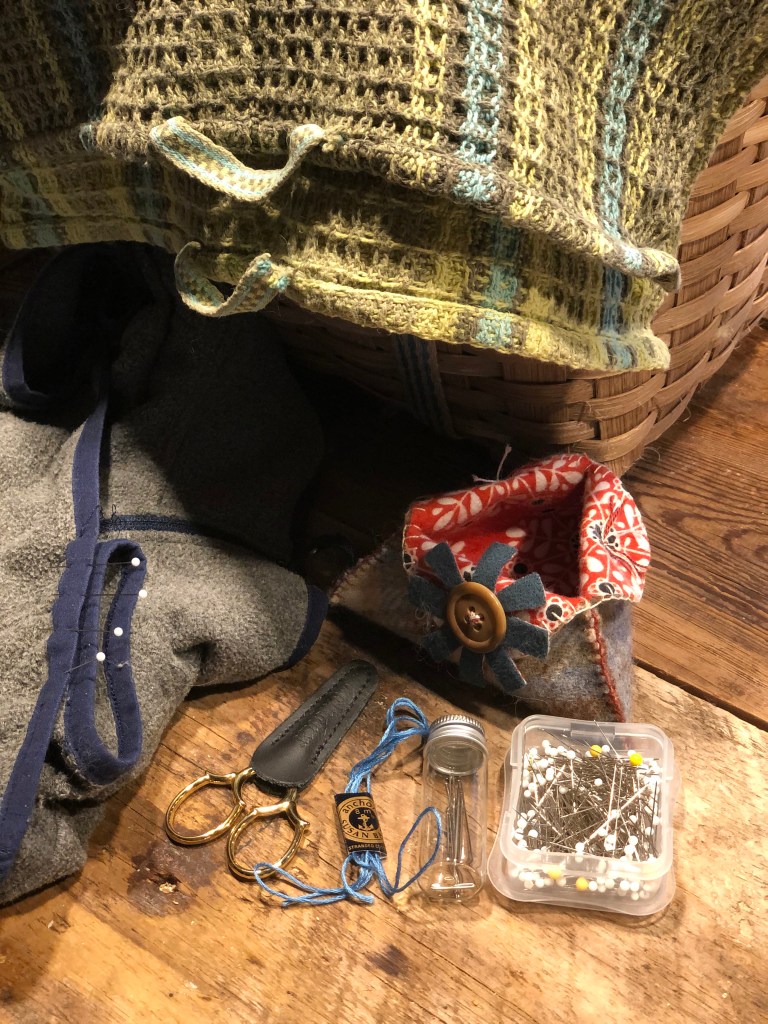
Today’s mending pile doesn’t afford me many opportunities for being whimsical. I have a pair of tea towels that need their hanging loops sewn back on. There is also a fleece mid-layer with a section of its binding coming off.  I’ll go with bright blue thread on each. 

Picture of my mending in a basket, with scissors, bright blue embroidery thread, pins, needles and a triangular wool ‘thread catcher’ for my snippets

My Gran liked to mend. She was frugal from habit more than from need. Gran wore cotton shirtwaist dresses with opaque stockings and black shoes that laced up and had sturdy two inch heels. Those dresses required sewing on the odd button, and the stockings were mended as needed. Throughout the house, table linens, bedding and even the cushions that the puppy chewed bore her small and neat stiches. 

Mum, in the other hand, hated mending. She often said that she would damn her stockings rather than darn them. 

I take the middle path. I would damn my holey stockings in an instant, if I actually wore stockings. I also mend things, mostly when the fabric is handwoven or it is a piece of beloved clothing. Lately, I have taken to mending almost everything. Shopping is difficult during the Great Pandemic, requiring that I buy things without trying them on. I still don’t know my body very well after loosing weight. Clothes that actually fit look impossibly small. Sometimes I need a medium to fit in the shoulders, but I wear a small or x-small in trousers. Since I am at home, seeing no one up close, why not mend if it gives me pleasure?

One tea towel only need a few catch stitches. If had let it go, the loop would have come loose in a week or two. The other one had the loop hanging by a thread. I stuffed it back in the hem and embroidered a star to hold it. I’m not sure what Gran would think of my approach to mending. I think it is jolly, and that’s what matters at the bungalow.