Wes Heil – Be well

I have been at my destination for several days now. How do I know I am here? The first sign is that I am content and I am no longer questing. The second sign is that I am very relaxed. Third sign is that I think I have heard a message.

This year I think I’ve heard two messages. The first was “you are doing the best you can.“ That is an important message for us in these unprecedented times of pandemic. As we struggle to make new routines familiar, we have a tendency to criticize ourselves .It goes something like this: Surely, in nine months of isolation, I should have accomplished (fill in the blank). …the book of photos that I didn’t edit…the weaving I did not do…

Guess what: it doesn’t really matter. I am alive. You are alive. I hope your basic needs are being met. You’ve had these months to become who you needed to be. Take a bow for that.

At the winter solstice, we tend to concentrate on that moment in time when the day grows longer. Another custom is intended to be a reminder of larger cycles, and that is bringing a remnant of last year’s yule log to burn with this year’s yule log. Where was I last year at this time? Just returned from a delightful visit with a friend who lives in New York City. We visited outdoor holiday markets, and marveled that the best thorn-proof trousers for hiking were sold so far from any real woodlands. I went into last year’s retreat happy but breathless. 

This year I began in blissful solitude and slipped into the rhythm of more solitude. Nothing to do. No striving. Just some burning questions that I have now forgotten. One was something about rebuilding community.

The second answer really applies to anything I may wonder about the path forward. Just two little words that answer all the questions about rebuilding community. The words are “yes, and” and they are to be used whenever you want to say “no, but.” The yes part acknowledges the feelings of the other speaker. Yes, they said that. You may not agree, but they did say it.Take a moment to acknowledge that, and then add on what you want to say. Don’t perch it atop that very sharp “but.” Say it calmly.
Lets take an example. Someone comes out with a strong anti-mask statement. They can’t wear one because…whatever. I should reply, “Yes, and I worry for your health because of that. I’m wearing a mask to help protect you and we should probably stand further apart to keep you safe. I don’t want you to get sick. I know the government didn’t understand at first how important masks were in keeping you and others safe, but now we know how crucial it is, so we will have to take extra care since you can’t wear one.
That’s about as loving a way as I can make my point. I didn’t insult the person or make all remarks about what they were doing to risk MY health. 
Now I begin the journey back to the world. I am planning a wassail for the apple trees on my land. It will be a bit low key, just my reedy little voice singing the Apple Tree Wassail, and offering a libation to the trees. Wassail. Wes Heil. Be well.
Peace and bliss

The peace of the season is becoming natural. It’s been four weeks since I started my retreat and I am turning toward the center, walking ever so slowly, and realizing that I am halfway there. At this point, the only thing I will buy until mid-January is food for the table. Such gifts as I am giving for Yule have already been made, wrapped, and already sent. You can have your shopping frenzy if you like but I will not join you. I have been that footsore shop clerk who sympathized with your amazement that all the good things were sold by Christmas Eve. Imagine that!

Work has slowed down on the treehouse, my handyperson’s days off don’t always match up with good weather. He stopped by to deliver roofing materials, because he does hope to get the roof on before winter comes. 

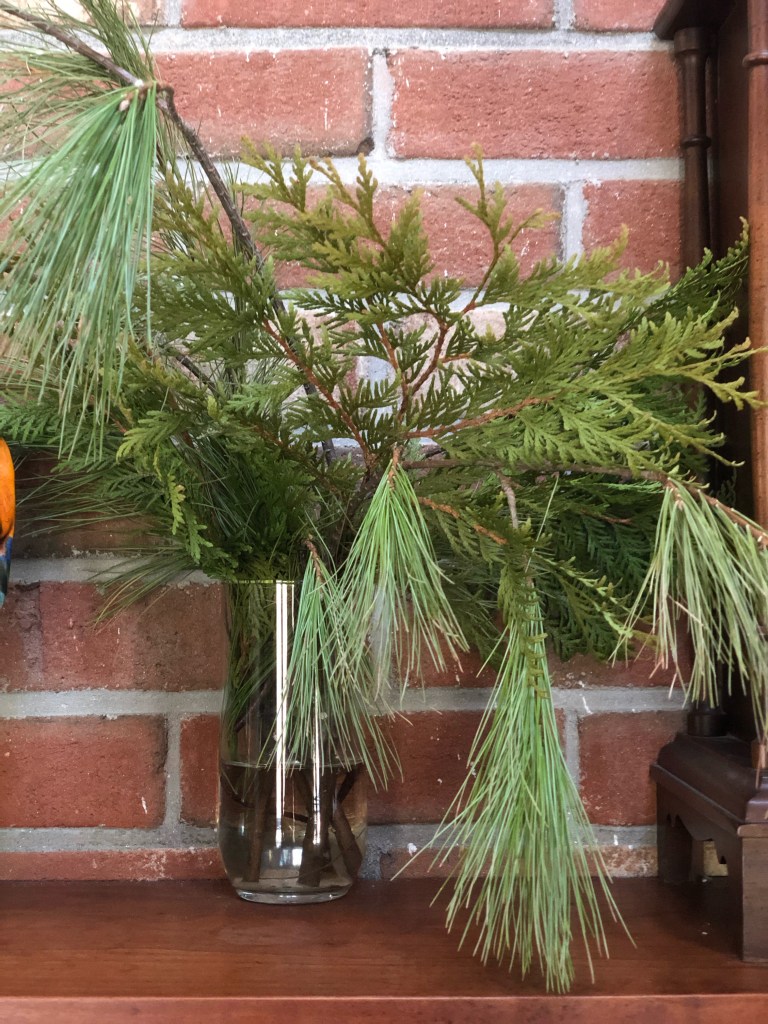
Inside the jolly bungalow, it is starting to get festive. The tree will be artificial this year. Because of the pandemic, I can’t consider going out to buy a tree an essential thing. I will go into my woodlands and trim an arm-load of evergreen and laurel branches, and collect small bits of wintergreen and princess pine. I will mix hinoki cypress and balsam essential oils, maybe adding a touch of cinnamon, clove, and bay laurel to the blend. It will be an old-fashioned Yule.

For Gran, Yule meant lots of baking. Fruitcakes were not a thing of scorn in her household  They were delicate and delicious, made with candied peel from her own pantry, loaded with nuts, and redolent with whisky. 

Mum baked gingerbread and made cookies. She reminisced about the fruitcakes but never made them. She celebrated Yule under a very thin veneer of a very old-fashioned Christmas. 

I bake bannocks, and decorate the jolly bungalow with a lot of pine cones in addition to the arm-load of greens. I make a lot of my decorations and it is a time of quiet joy and dreams of thick flakes falling. Winter is coming and I love it. 

Spiralling deeper

Another week passes, and another turn around the spiral is made. This one is easier, a sense of a worn-down path allows me to travel without thinking so much about my feet. The realization that all things are sacred makes the journey one of constant blessings acknowledged  and constant gratitude offered to the Spirits of the Place. I spend as much time outdoors as I can, slowly adjusting to November’s chill. I followed the beaver dam beyond the side of the pond and realized that in spring, this will be a marsh. I must enjoy this space while the dry autumn permits me to walk there. I am the only one of my family drawn to the marshes. My father preferred the mountains and Mum loved a cliff top walk. 

Sometime about now in the course of every retreat , I find that I am thinking less in words and more in colors and images. I have always said the color was my first language. I find myself less interested in analyzing or using words to describe things and more interesting in seeing and viewing the world in a series of images. It seems more direct and unfiltered.

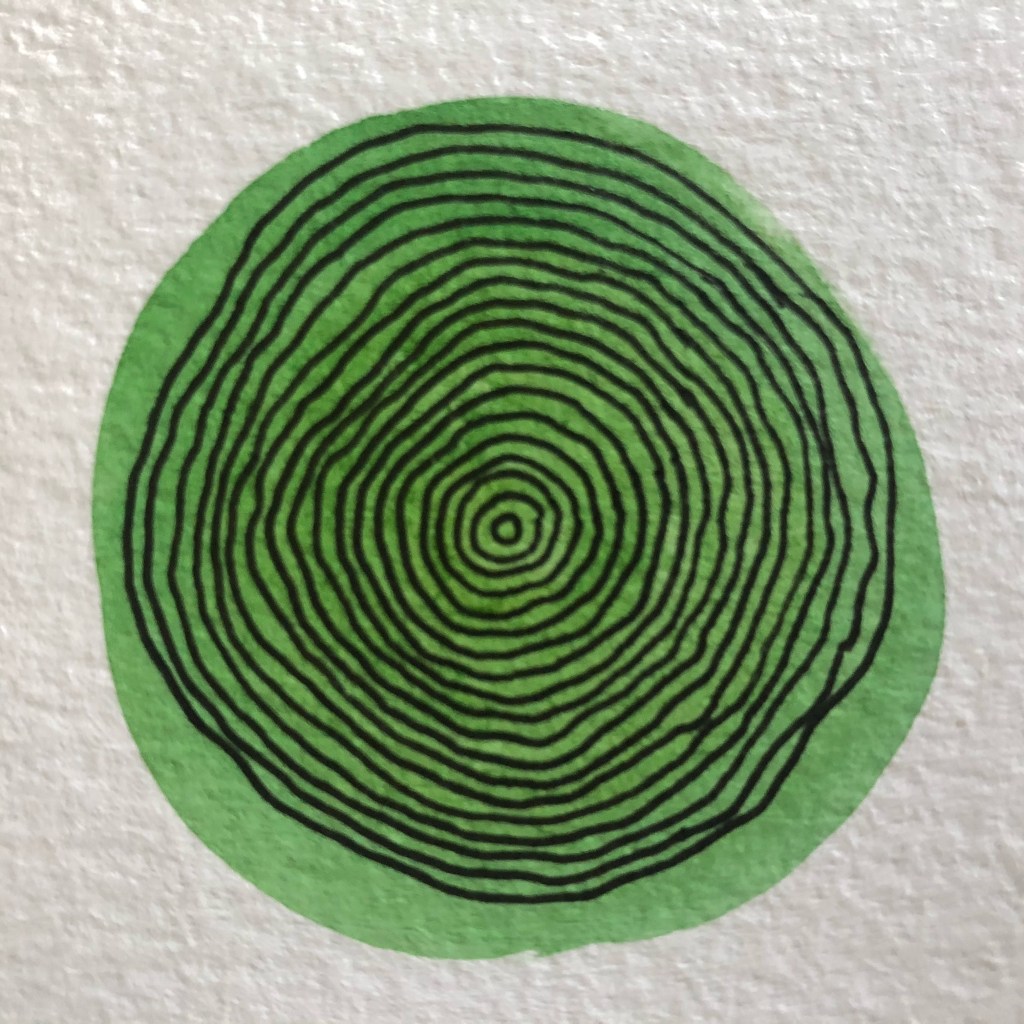
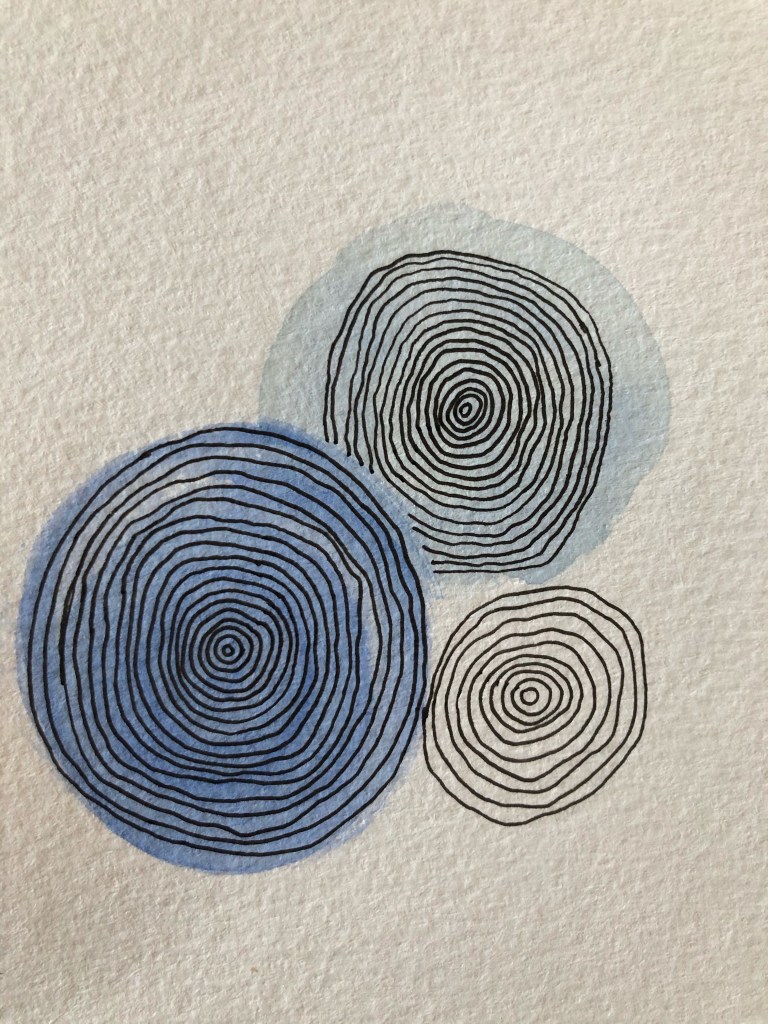
This mandala was supposed to be a sun symbol. That was how the workshop leader presented it. I am not so sure. My first reaction was that it was a symbol of self. I am the tiny circle at the center. Though it is not a spiral or a labyrinth I see a relationship to both symbols.
Most of all I see ripples on the pond. I am aware of how my tiny actions ripple outward into the community and beyond. This could be a gift when I am my best self and lead by example. I am aware that a beacon of light casts the same pattern in darkness. 
I am also aware that a lighthouse casts a warning of the proximate dangers. Wisdom is found in knowing the difference. Not all light should beckon.

The imperfections of my drawing remind me of fingerprints. Unique. Neither precise nor mechanical. This is a reminder to celebrate what is unique in each being. We all cast our own shadow and make our own ripples. The warning about lighthouses still applies. Does the community benefit or suffer from these ripples?

Draw your own conclusions from this one. Draw your own concentric circles and come to know how you touch the community and the universe beyond. 

Under the same Crescent Moon

Dark Moon, we hear you calling.

Bright Moon, we call your name.

Crescent Moon we sing with you.

Crescent Moon we sing with you.

Ivo Dominguez Jr.

For the past week, I’ve been on the first part of my spiral journey to stillness and to the center of the heart. The road has been rocky indeed, with the attraction of the political spectacle pulling me backwards toward the outer world. I allowed myself a day of unbridled joy and celebration, periodic reflection on the disappointment the other party must be feeling, as I remember my. own stomach-churning feeling of loss, four years ago. I slept very well for one rare night, and then picked up my bundle and continued on. I have rounded one circuit of the spiral, and the bustle of the world is fading away. The Jolly Bungalow is a backdrop to the journey, a refuge in the dark of night.

I am outdoors most of the day, seeking healing among the naked trees which stand tall. I have cut a narrow path from the treehouse to the pond. For the first time ever, I walked across the beaver dam. I didn’t grow up in the company of beavers, and would not have thought this possible, but it is like walking on a firm but narrow path, made especially firm by the very dry autumn. I got sidetracked by a large rock, and sat to gaze into the water and ponder my questions. Gran would have accused me of woolgathering, but my Grandfather would have understood.

The notion of common ground means something else in the woods. It is literally the ground beneath our feet. Hawley schist is the geologic term for what is deep underfoot. It is a metamorphic rock, changed to its current form by heat and pressure. How have I been changed by heat and pressure in my life? What is my current form? What about the glacial erratics which dot the landscape, boulders from elsewhere dropped by the movement of ancient glaciers? I’m sitting on one right now.  When we accept their otherness in the landscape, do we learn the skills to accept those who we initially see as other? Is that how common ground is formed?

The moon is a waning crescent right now, lingering in the daylight sky until early afternoon. This is another piece of common ground for us to experience. We all look to the same moon in the sky. We do not necessarily draw the same experience from it. We all see a shadow on a rock circling the earth, repeating the cycle of its phases every 29.3 days. I choose to keep my calendar by it, using a variation of the Druidcraft Calendar. See the site www.druidcraftcalendar.co.uk for more information. I also choose to acknowledge the Goddess Luna in the moon’s presence. I acknowledge that the First Nations call her Grandmother Moon and  humbly accept the Haudenosawnee words of thanksgiving which has been given freely beyond their nation. I appreciate this way of sharing common ground. 

Common ground. Getting down to bedrock. Common moon. Lifting our eyes to the sky.

Breathing deeply and letting peace flow through me. In the words of the Druid Prayer for Peace:

Deep within the still center of my being, may I find peace. 

Silently within the quiet of the grove, may I share peace.

Gently within the greater circle of humankind, may I radiate peace. 

Iolo Morganwg

Rushing to slow down

Here it is, the first week of November and I feel I am way behind in experiencing the season of Autumn. How did the leaves fall overnight? I should have picked apples. The outside stuff isn’t all put away for the season. Do I have enough firewood? Am I provisioned for winter?  Where are my wool base layers?  I race up and down the stairs from cellar to attic, finding things, looking with disgust at stuff I really don’t need, and experiencing the strangely elastic sense of time that both makes me feel unready and also lets me procrastinate too much.  Then there is the clock change, which I don’t actually participate in, but that requires constant temporal gymnastics to relate real time with civic time. Add back the hour for appointments and scheduled things to experience them in my time.  Switch my devices to Atlantic Standard Time (From Eastern Daylight Time) so that I can see the same sunset around 5:44 as I did yesterday.

Get a grip on it. It’s still Samhuinn season. You don’t leave for your six-week journey until dark. The panic creeps in. What do I take and what do I leave behind? Every year, I feel lost and left behind at the beginning. And, every year, I hear the echoes of my mother’s voice guiding me, “The road is rough and long. You’ve never been there before.  Pack light, but wear sensible shoes.”I nod and feel the stress washing away, but I have always wondered why I must wear sensible shoes on an inner journey. She always said it that way, with a smile and no explanation. At least I understand why I have not been there before. The inner landscape changes like a river. Although I journeyed there last year, it will be new. It always is. My mother’s advice had been reliable in the past, so I’ll pass the message along verbatim.

This year’s journey is even more new that usual. So much of what I am used to turning my back on doesn’t really exist any more. I have turned my back on some things for so many years that I hardly know they are a thing.  Shopping malls? It’s been years since  visited one. Advertisements? I’ve finally tuned them out. The holidays that most people celebrate? I celebrate Samhuinn and Alban Arthan (Yule). I do not celebrate Thanksgiving, Christmas, or a New Year in January. Samhuinn is my New Year, and this journey that I am undertaking is called the Spiral Journey to the Heart’s Center. I hope to arrive on Dec 21, and I’m leaving late tonight.

This isn’t something that all Wiccans or all Druids follow. It’s a family tradition, something born in the Jolly Bungalow. Gran always said that the pace of farm life slows down at this time of year. We spend more time indoors, especially after dark. We seek refuge in the silence, away from the overwhelming messages of what many other people celebrate. It’s easy to get lost in the herd, playing their holiday music, eating their proscribed holiday foods, desperately attending party after party but never finding truth or peace, and spending too much time on things that don’t matter.

I always have  a choice. I can opt out of the journey, or opt out of the frenzy. I prefer to follow the season, which is one of rest and recovery from the harvest. It’s time to plan the first steps of the new year. What if you didn’t jump right in on the first day, like others do with their resolutions and other silliness? What if you slowly followed a spiral path towards stillness, leading in to the heart’s center? Once there, you might have some answers instead of a lot of questions. Truth lies within the heart, but you have to listen intently for it because sometimes it whispers, or sometimes it shouts, but whatever is distracting you is shouting louder.

This year I have questions I hope to have answered. Some years I don’t find the questions until I have relaxed into the journey, but this year they bubble up and overflow. What is the gift of the pandemic? How will it shape my life to be kinder, more earth conscious, and more active as an ally in gaining social justice for those who have been denied it? How does a hermit accomplish these things?

My journey looks a lot like my daily life, but I try to slow down more, notice more, and think about my questions each day. I try to eliminate distractions, and make more things than I buy. I think about how the ancient Druids might have lived and spent their days. I will study by the fire. I have a bookbinding project and some weaving to keep my hands busy and my mind free. I will spend more time in the woods. Soon, I will have tea in my treehouse.

I won’t give up the thin and often interrupted connection that allows me to post this blog. I take no vow of silence; it is not our way. I will take a vow of careful thought before speech.

I have packed lighter than ever. I have my questions and my curiosity. What more could I need?

Of course there will be many windows

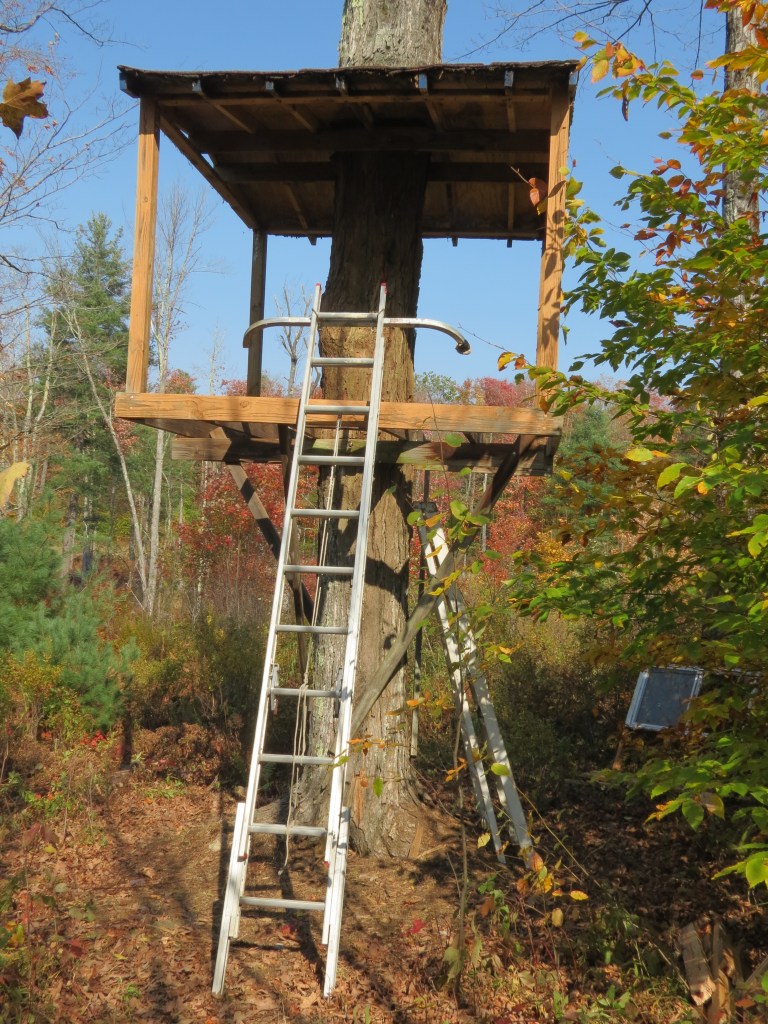
Work has begun in earnest on the treehouse. The first step was to remove anything that does not belong to the vision of the future. That included be the rotten floor, the plywood siding, and the luan walls and ceiling. The wall studs had to come out because the guy who built it put those on top of the floor, but they will go back in. It also included ten mice and a misplaced bird. It will include the leaky roof, but keeping that on serves a purpose for a little while longer, which is to cast some shade on the worksite. It will be replaced at some part of the project. We have something that currently looks like this, but I am beginning to imagine the next part. I know where to put the windows!

The new floor goes in next, followed by the wall frames(not sitting on top of the floor) which will have new lumber on the bottom, but use the old uprights. I’m not sure if the boards along the top will be new or old. I let my handy person decide what is possible to reuse and what to replace.

I climbed the ladder to approximate what the views might be from the windows. This is the view to the left. There will be three tall windows here, going right up to the corner post and two more windows to the right of the post. This is the best view, so it gets the most windows.

Looking straight ahead. There’s a tree in my way…of course. This is the second best view so it will get two windows. The other two walls don’t even rate a small window. There’s nothing spectacular to see there.

It’s peak foliage season here. I wonder if I would have been content with fewer windows had it been a less beautiful season?

I think this project means that I have figured out how to live within the new normal. I’m comfortable with the basics of getting the necessities of life, so I decided to figure out how to do a project safely with one worker onsite. I do wear a mask when I talk with my handy person, he wears one too, and I don’t linger on the worksite. It’s an outdoor project, but still…being cautious is how we will end this pandemic sooner, and I am all in favor of that.

The Folly

When I used to go shopping in a store, in that way that we did before the pandemic, one way that I used to make sure that I really needed something as opposed to just wanting it, was to set in back on the shelf and prepare to leave the shop. If I got to the door without any qualms, I probably just wanted the item. But if I felt any sort of connection to the object, or was already thinking of what would happen if I came back later and it gone, then I would go back and buy it.

This reminds me of the adage that you only miss something when it is gone. I guess this is what I was simulating when trying to leave without buying the object in question.

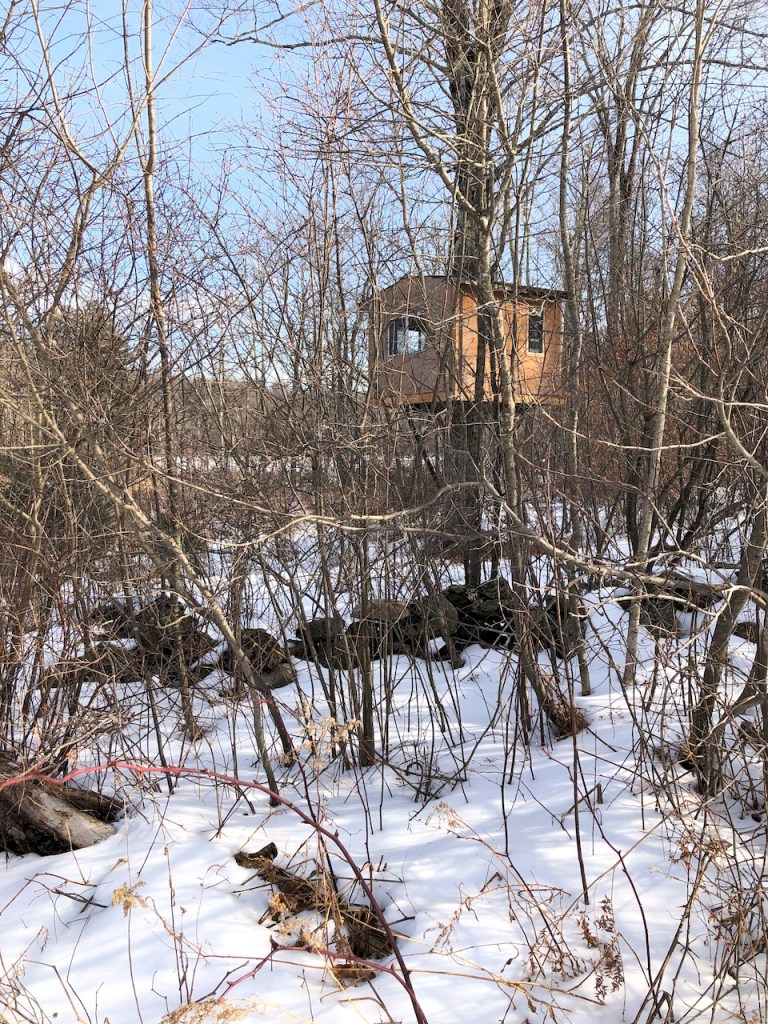
And that brings me to The Folly. I have a treehouse on my land, hidden in a thicket of Hornbeam. It came with the property. I always thought of fixing it up and going up there to write in my journal or to have a cup of tea. But all I ever did was think about it. For a person who lives in the jolliest of places, I didn’t really think I needed a retreat. What was I retreating from? Thus, I called it my Folly.

You can only see it in the winter.

The Folly in winter

Otherwise it is hidden by a thicket of Hornbeam.

When my homeowner’s insurance company took exception to the treehouse and threatened not to renew my policy, I considered tearing it down, and called my handy person to do that.  He helped convince me to fight the insurance company. I realized I couldn’t walk away from the treehouse. I needed that treehouse, even though I had never enjoyed using it. All of a sudden, I realized exactly what was wrong with it and what I needed to do to make it right. It needed a new roof—dark green metal, to be precise, and it needed weathered grey clapboards rather than faded-orange painted plywood on the sides.  The windows needed to be clustered at the corner with the best view rather than centered in the walls, and that would make me love it. I convinced the insurance company that all they wanted was a locking door and the ladder not stored underneath.  I can be compelling like that, and they agreed.

So, my handy person confirmed that the framework was sound and that the changes I wanted were totally feasible. The lumber was delivered yesterday, and we are going to make this a perfect place for me.

In my tradition of Druidry, we are encouraged to have a simple hut so that we can take a retreat from modern life and be close to nature. Many people choose to build a garden shed of sorts. I plan to be up in my treehouse. It will be a simply-furnished space, with a writing table, chair and a sleeping shelf. I won’t even have a stove, as it is not a permanent home. The ladder will come home with me at the end of the visit, and I have this curious padlock in the shape of a fish. It’s from Thailand, and it was explained to me that fish sleep with their eyes open, so they are thought to guard your space. I bought that padlock at a point when I lived in an apartment. It was a promise to myself for the time I would be home again and have an outbuilding. That promise is coming true. I have been home for years, and the right outbuilding was there all along, but I had to pretend to walk away until I could see it for what is was. 

Now, the treehouse will need a new name, since it is no longer a folly.

Autumn’s approach

Today at the Jolly Bungalow, it is a little chilly and I am starting to look forward to autumn with great joy. While summer is nice for raising a garden and sleeping under the stars, it’s also buggy and sticky. Autumn is crisp and fresh, and is the time for enjoying the harvest. My garden was promising in the spring, all but forgotten in the heat of summer, and I am pleased that it yielded lots and lots of tomatoes, which I have frozen and will someday turn into sauce.

I honestly don’t know how much of the garden I will have next year. This year‘s garden was part of a pandemic self-reliance, and I can’t say that I enjoyed it all that much. You are supposed to give a patch of ground a rest from growing tomatoes for a couple of years, so that may be my reason to have a much smaller garden next year, focused on herbs, lettuce, and a few flowers. I  really liked the four marigold plants that I planted this year, and after the frost I will gather the flower heads for dye. 

I see a lot of squirrels and chipmunks on my daily walk, because they’re in full harvest gathering  mode too. The sandhill cranes are still here and I am glad that the meadows of the bungalow are one of their favorite places to hang out.

The celebration of the autumn equinox is the celebration of the harvest, not just on the physical level but also on the spiritual level. This year I will gather together four things that represent different aspects of the harvest for me. Each item will answer one of these questions:

What inspires your mind?

What fires your passion?

What sustains you emotionally?

What sustains you physically?

After I’ve gathered this year’s symbols of the harvest together, I will look back in my journal from last year at this time and see how different last year‘s symbols were.I don’t know with any certainty, but I suspect they were symbolic of the wider world  that I lived in. This year they will be very much of this place. 

I wonder how much my love of this season is centered on the fact that I was born in it? Do I feel a sense of a return to the very first time that I knew, and am I influenced by the celebration of my birthday? One reason that brings this to mind is that my father also loved this season  and he celebrated his birthday eleven days after mine. 

All indications say that life at the bungalow will be much of the same for the better part of next year. Yet, it will be so much easier because I know to go about it now. In fact, I wonder if I will even want to go back to my old life? This time here has given me permission to live more simply and to know the land and its resident spirits more deeply. I have embraced the present moment. Why would I go back to a more superficial life?

Words Matter

It’s funny that I would say that words matter, given that my first language is color, but I am forced to make words out of the colors and patterns that flow through my brain if I want to communicate. I can’t say to you that I read an article in the local paper that made me feel all dull brown with big gray and black smudges. Well I could, but would you understand that it really made me feel uneasy and sad?

The article was about the troubling use of words on the website of a business in the southern Hilltowns. On the surface, they presented a very cautious and practical description of the COVID-19 precautions that were required of customers in their store. (Masks and social distancing. ) What was troubling about the post was that they continually referred to COVID-19 as “the China coronavirus.“ Not just once, but four times. 

That is not kind. The US owns the pandemic within its borders. A strong response could have curtailed it, but we had a weak, do-nothing response. It’s the US coronavirus now.

Divisive language does nothing to help anyone. You see, language does matter. When people use an ethnic slur or say something that makes part of the population into the “other” they are opening a path to habituation, and that allows for subtle and continuous escalation of dehumanizing part of the population. Verbal unkindness takes root and keeps growing. After a while hateful words have become so common that people stop viewing the target as a person like themselves, and  that opens up the possibility for more than words to be thrown at people. That’s when the rock start going through windows. That’s when the rocks start going at people. Don’t think that words are weak or harmless.

Here at the Jolly Bungalow I try to be as respectful as possible in my speech. It’s not a sign of weakness; it is a sign of good manners and considerate behavior.

What am I going to do about that shop? For one thing, name names. It is the Huntington Country Store. They have not apologized for being insensitive, and have doubled down, ranting against Chinese Communism and for freedom of speech. OK, it’s their right to have opinions. And it’s my right to realize that the shop is owned by people I don’t agree with or particularly want to spend money with. They made a choice to be mean-spirited rather than apologetic, and they can face the consequences. Under capitalism, my dollar is a vote and I do not vote for them. Speech can be free but it still has consequences.

We have many Chinese-Americans living in this country and they are not “other.” They are us. China is the most populous country the world. Do you know it’s history? Have you studied Chinese art or poetry? Looked at the beauty of traditional calligraphy? And don’t dismiss Communism as inherently bad. All systems have their strengths and weaknesses. We were sold a lot of propaganda during the Cold War and it still colors some people’s views. Be objective. How’s capitalism working for you right now? Not very well for most ordinary people. Racism and capitalism are a two-headed monster, since capitalism needs a weakened underclass to feed upon. Don’t fall or it.

It is never a sign weakness to use kind language. It shows you to be a leader rather than a bully. I am lucky that I can use the grandma test to see how I am doing in kind speech. If I wouldn’t dared to have said it in front of Gran, I probably should not say it now.

The Gleaming Board

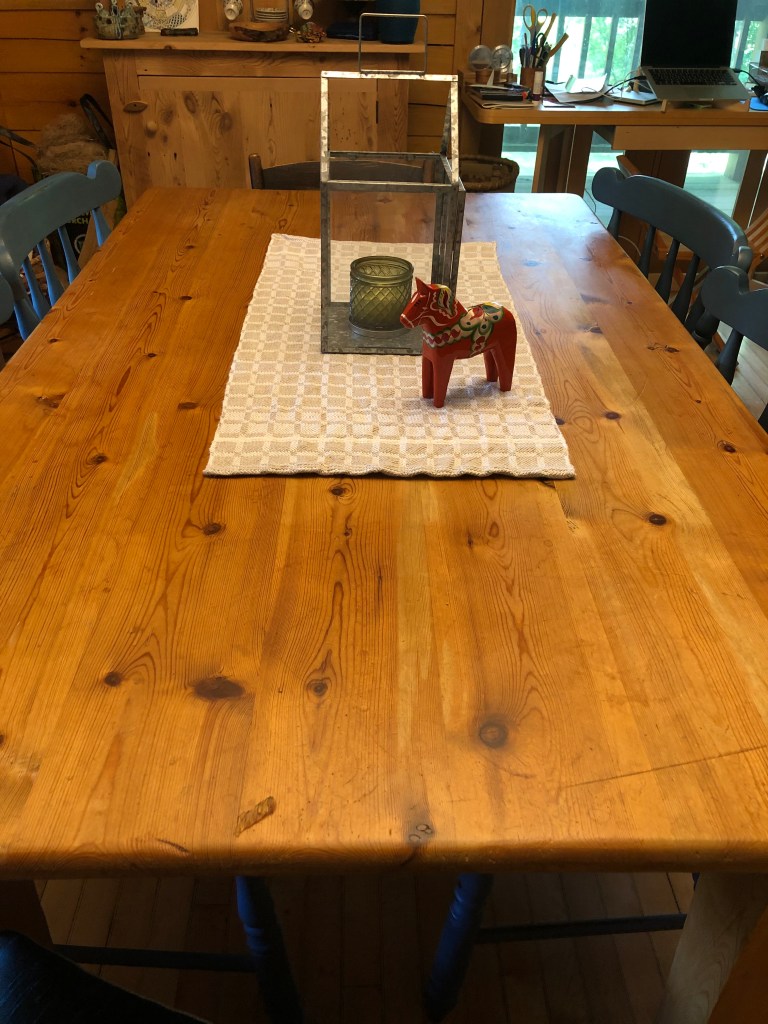
Today I polished the dining room table, rubbing the fragrant mixture of oils and beeswax first in circles, and then when the oil had soaked into the wood and left a dry film of beeswax on top of the table, I rubbed it in a long strokes until it gleamed. 

Then I chose a cloth for the center, this one a combination of bleached and unbleached linen that I had woven last year. In the center of the cloth, I placed a candle in a cat-proof hurricane lantern, and a red Dala horse.

My dining table is made of simple pine, and it’s not a family heirloom although it has enough dents and dings to resemble one.

It was rescued from a roadside tag sale some seven years ago  It was unfinished, stained with countless rings of coffee, and so filthy that I recoiled from touching it. But how could I abandon it? I have a soft touch for a piece of furniture that has been mistreated. This one was begging for some love. What sealed the deal was that it would just fit into the width of my Land Rover, and it only hung out a foot or so in length. I was ill-prepared for buying furniture that day, and had no rope to tie it in. I figured that if I drove slowly it would stay put. 

Not really. 

It nearly slid out of the car when I started to go uphill. I pulled the car to the kerb and fashioned a makeshift tether using the belt from a robe I’d purchased earlier in the day. I live in the Hilltowns, and the trip home was almost entirely uphill. Crisis averted.

In the weeks that followed, I sanded all the crud, stains, and neglect from the surface. There were some very deep digs and scratches that I couldn’t sand out, but I like them. It reminds me of the hard life that this table had, and it reminds me of who I am. I don’t love perfection, and I’m happiest when I rescue a friendly but miss-matched group of furniture from the roadside and invite them into my home.

My Gran would be horrified. She had a well-matched set of walnut furniture in her dining room, and while it had seen generations of use, the gentle scratches were barely perceptible. She used a concoction of dark furniture polish to keep it gleaming. Her grandchildren used to call that polish “Multitude of Sins” because she used to say it was the only polish that would cover a multitude of sins.

Mum had a oval oak dining table that she adopted when cousin L was forced to accept a table that had belonged to someone in her mother-in-law’s family. Maybe I get that furniture-rescuing gene from her. But not long after my father passed away, Mum replaced the table. She said that she didn’t want to dine with his ghost every evening. 

Right now, I would welcome few ghosts to the table. It’s been a long time since the the chairs have been full. It seats six (seven if you put two children at the foot). 

Come Samhuinn, I’ll set the table for six and invite a few ancestors to join me for a silent but jolly supper at the bungalow.